Incoterms Explained for SMEs: Risk, Cost, Responsibility, and Strategic Decision-Making in International Trade
Incoterms Explained for SMEs: Risk, Cost, Responsibility, and Strategic Decision-Making in International Trade
Agustin Baldovino
CEO Sales in a Box AB
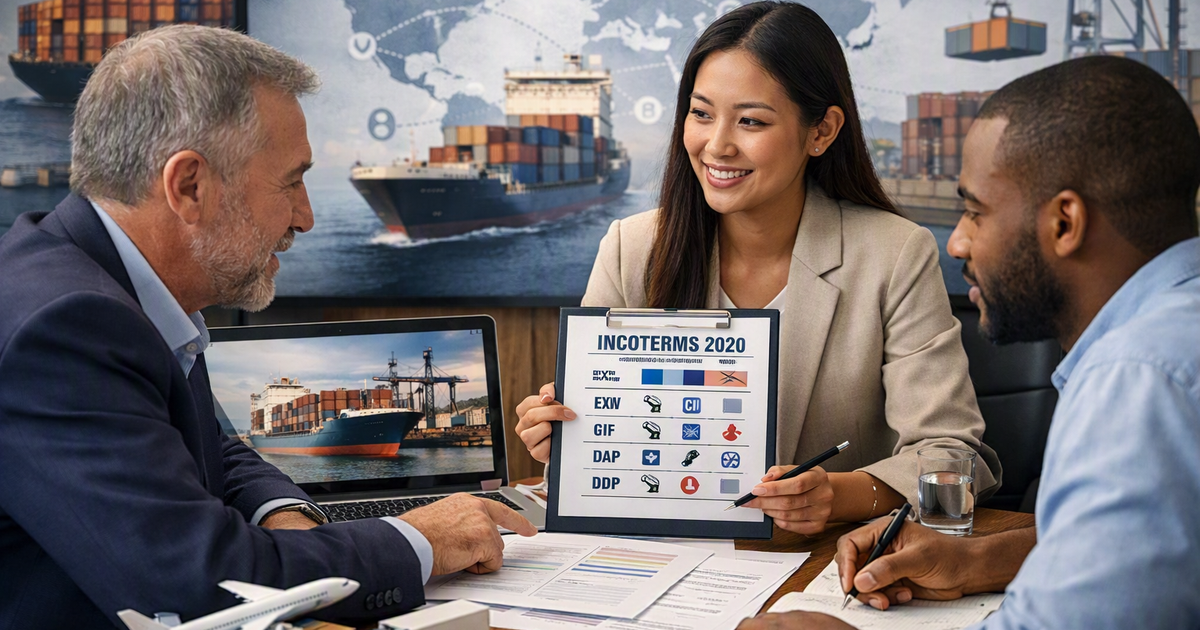
International trade depends not only on price, product quality, and market access, but also on the precise allocation of responsibility between buyer and seller. In cross-border transactions, goods move through several legal, logistical, and financial stages: packaging, inland transport, export clearance, loading, international carriage, insurance, unloading, import clearance, and final delivery. Each stage creates possible costs and risks. Incoterms, formally known as International Commercial Terms, provide a standardized language for allocating these responsibilities in contracts for the sale of goods. Published by the International Chamber of Commerce, the Incoterms 2020 rules consist of eleven internationally recognized trade terms that clarify the division of tasks, costs, and risks between commercial parties (International Chamber of Commerce, 2026a). Their importance is especially significant for small and medium-sized enterprises, because SMEs often operate with narrower margins, less bargaining power, and fewer specialized logistics resources than large multinational companies.
For SMEs, Incoterms should not be treated as minor technical abbreviations placed at the end of an invoice. They shape the economic substance of a transaction. A sale under Ex Works exposes the buyer to nearly the entire logistical chain, while a sale under Delivered Duty Paid places extensive responsibility on the seller, including import clearance and duties. Between these extremes are rules that distribute obligations in more balanced ways, such as Free Carrier, Carriage Paid To, Carriage and Insurance Paid To, Delivered at Place, Free on Board, Cost and Freight, and Cost, Insurance and Freight. The practical effect is that two contracts with the same product price may be very different in total cost, cash-flow exposure, and risk allocation once transport, insurance, customs, delay, and administrative burdens are considered.
The central function of Incoterms is to identify the point at which risk transfers from seller to buyer and to clarify which party must arrange and pay for key logistical steps. Risk transfer is not always the same as cost responsibility. This distinction is one of the most common sources of misunderstanding. Under CIF, for example, the seller pays for carriage and minimum insurance to the destination port, yet the risk transfers to the buyer once the goods are loaded on board the vessel at the port of shipment. This means that a buyer may bear the commercial consequences of damage during the ocean voyage even though the seller arranged and paid for transport. Such examples demonstrate why Incoterms require careful interpretation rather than casual use.
The Incoterms 2020 framework divides the eleven rules according to whether they may be used for any mode of transport or only for sea and inland waterway transport. The rules for any mode of transport are EXW, FCA, CPT, CIP, DAP, DPU, and DDP. The maritime-only rules are FAS, FOB, CFR, and CIF. This classification matters because using a maritime rule for containerized or multimodal transport may create legal and practical uncertainty (International Chamber of Commerce, 2026b). For example, FOB is often used casually for container shipments, but the point of delivery under FOB is when the goods are loaded on board a vessel. In modern container logistics, the seller may hand over the goods to a terminal or carrier before the container is loaded onto the ship, leaving a gap between physical control and contractual risk allocation. For that reason, FCA is often more suitable for containerized exports because it aligns better with delivery to a carrier or named place.
Ex Works represents the minimum obligation for the seller. The seller makes the goods available at its premises or another named place, while the buyer assumes responsibility for collection, export procedures, main carriage, insurance, import clearance, and final delivery. Although EXW may appear attractive to sellers because it limits their logistical responsibilities, it can be problematic in practice. In many jurisdictions, the seller may be better positioned to complete export clearance than the foreign buyer. If the buyer lacks local knowledge or operational capacity, the shipment may be delayed even before leaving the seller’s country. An SME using EXW should therefore ask whether the buyer can realistically control export formalities and whether the commercial relationship can tolerate delays caused by documentation problems.
Free Carrier is often a more practical alternative for SMEs because it allows the seller to deliver the goods to a named carrier or place while usually handling export clearance. FCA can be adapted to different logistical structures, including delivery at the seller’s premises or at a freight terminal. Its flexibility makes it valuable for multimodal transport and containerized cargo. For a Swedish SME exporting machine components to Germany, FCA could mean that the seller prepares the goods, clears them for export, and hands them to the buyer’s carrier at a named warehouse or terminal. Risk then transfers at that point, giving both parties a clearer operational boundary than EXW usually provides.
FOB, CFR, and CIF remain widely used in traditional sea trade, but their suitability requires attention to the type of cargo and the point of delivery. Under FOB, the seller delivers the goods on board the vessel at the port of shipment, and risk transfers when loading is completed. Under CFR, the seller also pays the cost of freight to the destination port, but risk still transfers at the port of shipment. CIF adds an insurance obligation for the seller, yet the insurance requirement is limited unless the parties agree to broader coverage. These rules can work well for bulk commodities or non-containerized cargo, but they can be misleading when used for container shipments handled through terminals. SMEs should therefore avoid selecting FOB or CIF merely because they are familiar terms and should instead match the rule to the physical movement of the goods.
Delivered at Place and Delivered Duty Paid are particularly important for SMEs that compete by offering convenience to customers. Under DAP, the seller carries the risk and cost of transporting the goods to the named destination, but the buyer remains responsible for import clearance, duties, and taxes. Under DDP, the seller assumes the maximum obligation by delivering goods ready for the buyer while also handling import clearance and paying duties and taxes. DDP may be commercially attractive because it creates a simple purchasing experience for the buyer, but it can be dangerous for sellers that do not understand the destination country’s customs rules, tax registration requirements, product compliance obligations, or import licensing procedures. A seller that agrees to DDP without local expertise may unintentionally accept liabilities that exceed the profit margin of the sale.
Insurance is another area where Incoterms have deep practical consequences. Incoterms do not automatically guarantee full protection against all transport losses. Only CIF and CIP require the seller to arrange cargo insurance, and even then the level of coverage differs under Incoterms 2020. ICC Academy materials emphasize that CIP and CIF allocate insurance obligations differently and must be selected with attention to transport mode, risk, and the nature of the goods (ICC Academy, 2024). SMEs should therefore distinguish between the obligation to arrange insurance and the adequacy of the insurance for a particular shipment. High-value machinery, fragile goods, temperature-sensitive products, or goods exposed to theft may require broader coverage than the minimum insurance associated with standard terms. A university-level analysis of Incoterms must therefore treat insurance not as an administrative detail, but as a financial risk-management instrument.
Incoterms also influence pricing strategy. When a seller offers a price under EXW, the quoted price may appear low because many transport and customs costs remain outside the seller’s responsibility. By contrast, a DAP or DDP price includes more services and therefore may appear higher, even though it may provide greater certainty to the buyer. SMEs must understand this relationship when comparing supplier offers or preparing export quotations. A buyer comparing an EXW offer from one supplier with a DDP offer from another is not comparing equivalent commercial positions. The correct comparison requires estimating the total landed cost, including freight, insurance, customs brokerage, duties, taxes, port charges, storage, and possible delay costs.
The relationship between Incoterms and payment terms is equally significant. If payment is triggered by shipment, delivery, arrival, or document presentation, the chosen Incoterm affects when each party has fulfilled its core obligations. In documentary collections and letters of credit, transport documents can become central evidence that delivery has occurred. A mismatch between the Incoterm, the payment clause, and the required documents may create disputes even when the goods themselves are acceptable. For example, if a contract requires an on-board bill of lading but the shipment is organized under a multimodal arrangement where the seller delivers to a terminal before loading, the documentation may not correspond neatly to the commercial arrangement. SMEs should therefore align Incoterms with payment conditions, documentary requirements, and the operational reality of the shipment.
Customs responsibility is another decisive factor. Export and import clearance require accurate classification, valuation, origin documentation, licenses, and compliance with restricted-goods regulations. An SME may be experienced in its domestic market but unfamiliar with customs procedures abroad. Under DDP, the seller must manage import formalities in the buyer’s country, which may require tax registration or a local representative. Under DAP, the seller avoids import clearance but still bears transport risk until the named destination. These differences show that Incoterms are connected not only to logistics but also to regulatory compliance. Trade facilitation research stresses that simpler, more predictable, and more efficient border procedures reduce compliance burdens and support the participation of smaller firms in international trade (International Trade Centre, 2026; UNCTAD, 2026). Choosing a term without understanding customs obligations can convert an ordinary sale into a costly administrative problem.
From a strategic perspective, Incoterms can strengthen or weaken an SME’s bargaining position. A seller that understands logistics may offer more attractive delivery terms and thereby differentiate itself from competitors. A buyer that understands Incoterms can negotiate for terms that reduce uncertainty and improve control over transport. However, accepting more responsibility should be an intentional commercial decision, not the result of habit or pressure from a larger trading partner. SMEs should assess their operational capacity, insurance arrangements, cash-flow constraints, experience with freight forwarders, and customs knowledge before agreeing to any Incoterm.
Common mistakes arise when firms use outdated rules, abbreviate terms incorrectly, omit the named place, or fail to specify the version of the rules. A contract should not merely state “FOB” or “DAP”; it should identify the exact place and the applicable rules, such as “FCA Seller’s Warehouse, Malmö, Incoterms 2020” or “DAP Buyer’s Facility, Barcelona, Incoterms 2020.” The named place is essential because it determines where delivery occurs and where risk transfers. Without this precision, parties may disagree about whether the seller’s responsibility ended at a port, terminal, warehouse, border point, or final destination.
A practical way for SMEs to approach Incoterms is to begin with three questions. First, where should risk transfer from seller to buyer? Second, which party is best able to arrange transport, insurance, and customs clearance at each stage? Third, how should the chosen term align with price, payment, documentation, and customer expectations? These questions encourage firms to treat Incoterms as part of contract design rather than as a routine shipping label. They also help prevent the assumption that the party paying for transport is always the party bearing risk, which is not true under several Incoterms.
Real examples illustrate these issues clearly. A Swedish manufacturer selling spare parts to a German distributor under EXW may believe it has avoided responsibility, but if the buyer fails to manage export documentation correctly, the seller may still face delays, customer dissatisfaction, or reputational damage. A Bangladeshi garment exporter using FOB for a container shipment to Rotterdam may create uncertainty if the goods are handed to a terminal before vessel loading. A Chilean wine producer selling under CIF to Sweden may pay for insurance but still transfer risk once the goods are loaded at the origin port. A UK electronics exporter agreeing to DDP delivery in Norway may satisfy the customer’s preference for convenience but must understand Norwegian customs, VAT, and product compliance obligations. These examples show that the best Incoterm is not universally the one with the lowest cost or the greatest convenience; it is the one that fits the transaction’s risk profile and the parties’ capabilities.
In conclusion, Incoterms are a foundational tool in international trade because they transform complex logistical responsibilities into standardized contractual language. For SMEs, their value lies in reducing ambiguity, supporting cost calculation, improving risk management, and preventing disputes. Yet Incoterms are not a substitute for a complete sales contract. They do not determine the transfer of ownership, the method of payment, product quality obligations, dispute resolution, or the full content of insurance coverage. A sophisticated use of Incoterms therefore requires integration with the broader commercial agreement. When SMEs select Incoterms deliberately, specify the named place and version, and align the term with transport mode, insurance, customs, pricing, and payment, they can participate in international trade with greater confidence and professionalism (International Chamber of Commerce, 2026a; ICC Academy, 2024).
References
ICC Academy (2024) Incoterms® 2020: CIP or CIF? Available at: ICC Academy knowledge hub.
International Chamber of Commerce (2026a) Incoterms® 2020: The official rules of global trade. Available at: International Chamber of Commerce website.
International Chamber of Commerce (2026b) Incoterms® rules. Available at: International Chamber of Commerce website.
International Trade Centre (2026) Trade facilitation. Available at: International Trade Centre website.
UNCTAD (2026) Trade facilitation. Available at: UN Trade and Development website.
Agustin Baldovino
CEO Sales in a Box AB
Founder, board member, and international growth executive with 20+ years of experience building, scaling, and governing data‑driven and sustainable businesses across Europe, Latin America, the US, and emerging markets