Understanding Tariffs, Non-Tariff Barriers, Free Trade Agreements, and Rules of Origin.
This paper examines how tariffs, non-tariff barriers, free trade agreements, and rules of origin structure international market access for small and medium-sized enterprises, with particular attention to compliance costs, preference utilization, and the legal logic of origin determination.
Agustin Baldovino
CEO Sales in a Box AB
Understanding Tariffs, Non-Tariff Barriers, Free Trade Agreements, and Rules of Origin.
This paper examines how tariffs, non-tariff barriers, free trade agreements, and rules of origin structure international market access for small and medium-sized enterprises, with particular attention to compliance costs, preference utilization, and the legal logic of origin determination.
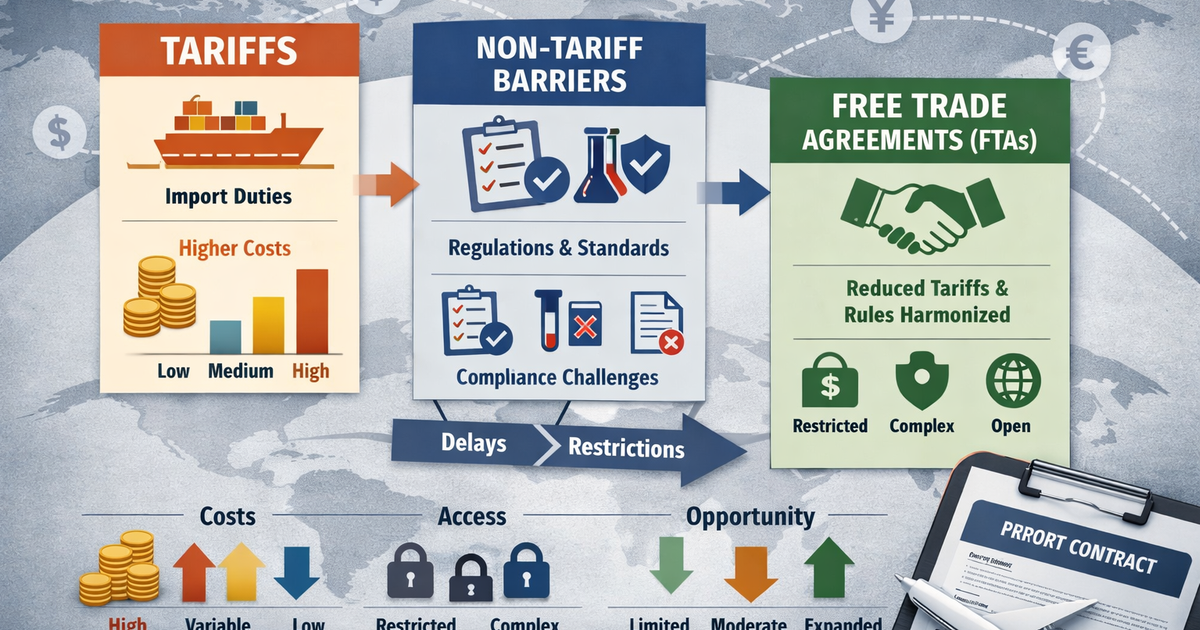
International trade is not governed only by prices, demand, and transport costs; it is also structured by a dense legal and administrative framework that determines whether goods may enter a foreign market, under what conditions they may be sold, and whether they qualify for preferential treatment. For small and medium-sized enterprises (SMEs), this framework is especially important because smaller firms often lack the financial, legal, and technical capacity available to multinational corporations. The main instruments shaping market access are tariffs, non-tariff barriers, free trade agreements, and rules of origin. Tariffs affect the direct cost of importing a product, non-tariff barriers determine the regulatory conditions under which the product may be admitted, free trade agreements create preferential pathways into markets, and rules of origin decide whether a product is legally entitled to benefit from those preferences.
The importance of these instruments has increased as global production has become fragmented across multiple countries. A product may be designed in one state, assembled in another, and made from components originating in several others. In this context, customs authorities cannot simply treat the country of shipment as the country of origin. Instead, they must determine the product’s “economic nationality,” a concept used by the World Customs Organization to explain the legal function of rules of origin. This distinction matters because the country from which goods are exported is not necessarily the country from which they originate. Origin determines whether a tariff preference applies, whether anti-dumping or safeguard measures may be imposed, whether origin marking is required, and whether trade statistics correctly capture the structure of production.
For SMEs, market access should therefore be understood as a layered problem rather than a single customs question. A firm may first calculate the ordinary customs duty applicable to its product, but that calculation is incomplete unless the firm also examines technical standards, sanitary or phytosanitary measures, labeling obligations, product testing requirements, documentation rules, and origin criteria under any relevant trade agreement. A market with low tariffs can still be commercially inaccessible if regulatory compliance costs are high or if certification must be repeated in the importing country. Conversely, an FTA may offer a zero tariff rate, but the benefit is lost if the exporter cannot prove that the product satisfies the applicable rule of origin.
Recent evidence confirms that the real cost of trade is increasingly regulatory rather than purely tariff-based. UNCTAD’s May 2026 Global Trade Update reports that non-tariff measures impose higher export costs than tariffs for 88 percent of countries, while tariffs increased sharply in 2025 by 10 percent for developed countries, 16 percent for developing countries, and 18 percent for least developed countries. The same report notes that least developed countries lose about 10 percent of their exports to G20 markets because they cannot meet non-tariff requirements. These findings are particularly relevant for SMEs because fixed compliance costs, lack of transparency, and limited access to accredited testing facilities disproportionately affect smaller exporters.
Tariffs remain the most visible trade barrier because they are formally imposed at the border and can usually be expressed as an ad valorem percentage of the customs value of the goods, as a specific duty per unit, or as a mixed duty combining both methods. Their economic effect is direct: they raise the landed cost of imported goods and influence the final price paid by consumers or downstream firms. For an SME, even a moderate tariff may determine whether an export transaction remains profitable, particularly when the firm competes against domestic suppliers or foreign competitors benefiting from preferential access under an FTA. Tariffs also shape sourcing decisions, because imported inputs subject to duties may raise production costs before the final product is exported.
However, tariffs should not be analysed only as taxes. They are also instruments of trade policy, industrial policy, and bargaining power. States may use tariffs to protect sensitive sectors, respond to unfair trade practices, encourage local production, or pressure trading partners in negotiations. This means that tariff levels can change quickly, creating uncertainty for firms that plan production and sales months in advance. Academic research on trade policy uncertainty suggests that smaller firms are less able to absorb sudden cost increases or reorganize supply chains when tariff regimes shift. Large firms may diversify suppliers, relocate stages of production, or use customs specialists; SMEs often operate with narrower margins and fewer alternative suppliers.
Non-tariff barriers are more difficult to identify than tariffs because they are embedded in regulatory systems rather than presented as a single customs charge. They include technical regulations, sanitary and phytosanitary rules, conformity assessment procedures, import licensing, quotas, labeling rules, certification requirements, inspection procedures, and administrative documentation. Many of these measures pursue legitimate public objectives such as consumer safety, environmental protection, public health, and product quality. The difficulty is that even legitimate regulations may operate as barriers when they are complex, duplicative, opaque, inconsistently applied, or expensive to satisfy.
The effect of non-tariff measures is often equivalent to adding a hidden tariff to the transaction. If a firm must redesign packaging, translate labels, obtain laboratory tests, hire consultants, pay certification fees, or delay shipment while awaiting regulatory approval, these costs reduce competitiveness even when the formal customs duty is low. For SMEs, the burden is particularly severe because many compliance costs are fixed rather than proportional to firm size. A certification fee that is manageable for a multinational company may be prohibitive for a small exporter shipping limited quantities. As a result, NTBs can create market concentration by favouring firms with greater compliance capacity.
The central academic point is that NTBs shift the analysis of trade barriers from border taxation to regulatory capability. A firm’s ability to export depends not only on production efficiency but also on its capacity to collect information, interpret foreign legal requirements, document compliance, and prove conformity to authorities or private buyers. The World Bank has emphasized that non-tariff measures have become increasingly prominent and complex, and that they may disproportionately affect smaller firms by increasing fixed compliance costs and encouraging market exit. From a development perspective, this means that trade liberalization through tariff reduction is insufficient if exporters cannot meet regulatory conditions in practice.
Free trade agreements are often presented as instruments for reducing tariffs, but modern FTAs are more accurately understood as comprehensive legal frameworks for governing economic integration. They may reduce or eliminate tariffs, establish customs cooperation, promote regulatory transparency, encourage mutual recognition of standards, create dispute-resolution mechanisms, and set detailed rules for services, investment, digital trade, intellectual property, government procurement, labour, and the environment. For goods trade, however, the central practical issue is whether the exporter can claim preferential tariff treatment. This is where rules of origin become decisive.
Rules of origin are the legal criteria used to determine the economic nationality of a product. They exist because tariff preferences under an FTA are not intended to benefit every good shipped through an FTA partner; they are intended to benefit goods genuinely produced or sufficiently transformed within the territory of the parties. Without rules of origin, firms could engage in simple transshipment by routing goods from non-member countries through an FTA member in order to avoid tariffs. Rules of origin therefore protect the integrity of preferential agreements, preserve customs revenue, and prevent trade deflection.
A fundamental distinction must be made between non-preferential and preferential rules of origin. Non-preferential rules of origin are used for general trade policy purposes, including most-favoured-nation treatment, anti-dumping and countervailing duties, safeguards, origin marking, tariff quotas, public procurement, sanctions, and trade statistics. Preferential rules of origin, by contrast, are used to decide whether a good qualifies for reduced or zero customs duties under an FTA or another preferential arrangement. The WTO Agreement on Rules of Origin seeks to promote transparency, predictability, and consistency in origin regimes, while the World Customs Organization provides technical guidance on how origin rules are applied in customs practice.
Preferential and non-preferential origin also differ in their legal consequences. Preferential origin is voluntary in the sense that a firm claims it only when it wants to obtain a reduced or zero tariff under a specific agreement. If the firm does not claim preferential treatment, the product can still be imported, but the ordinary most-favoured-nation tariff applies. Non-preferential origin is not optional in the same way, because customs authorities may need it even where no trade preference is claimed. For example, if the European Union imposes an anti-dumping duty on bicycles originating in a particular country, the decisive question is not whether the bicycles qualify under an FTA but whether their non-preferential origin is that country. Likewise, if an importing state requires “Made in” marking, restricts goods from a sanctioned territory, applies a tariff quota, or compiles official trade statistics, non-preferential origin determines how the good is treated.
This distinction can be illustrated through a simple example. Suppose a Swedish SME imports electric motors from China, plastic casings from Vietnam, and circuit boards from Germany, and then assembles finished household appliances in Sweden for export to Canada. Under the EU–Canada trade agreement, the SME may obtain preferential tariff treatment only if the finished appliance satisfies the agreement’s product-specific rule of origin. That rule may require a change in tariff classification, a minimum percentage of EU-originating value, or a combination of both. If the rule is met and the exporter can issue or support a valid origin declaration, the appliance may enter Canada at a preferential tariff rate. If the same appliance is exported to a country with no relevant FTA, preferential origin is irrelevant, but non-preferential origin may still matter for origin labelling, trade statistics, public procurement eligibility, or the application of trade defence measures.
The main origin criteria are wholly obtained goods and substantial transformation. A good is wholly obtained when it is entirely produced in one country, such as minerals extracted there, crops harvested there, or live animals born and raised there. This criterion is relatively straightforward, but it applies mainly to natural products and simple agricultural or extractive goods. Most manufactured goods involve inputs from multiple countries, so customs authorities must determine whether the last production process amounts to substantial transformation. Substantial transformation is commonly measured through a change in tariff classification, a regional value content requirement, or a specific processing operation. These criteria are often product-specific and are usually linked to the Harmonized System classification of the final product and its inputs.
A change in tariff classification rule requires that non-originating materials used in production be classified under a different chapter, heading, or subheading from the final good. This approach treats a meaningful change in customs classification as evidence that production has transformed the imported inputs into a new product. A regional value content rule requires that a specified percentage of the product’s value be added within the FTA territory. This method is common in sectors where classification changes may not capture the economic substance of production. A specific processing rule requires that certain manufacturing operations be performed in the territory of the parties. These rules are important in sectors such as textiles, chemicals, food processing, and machinery, where the nature of production may matter more than the tariff heading alone.
Practical examples show why origin analysis can become complex. Coffee beans harvested in Colombia and merely roasted and packed in another country may remain Colombian in non-preferential origin analysis if the later operation is considered insufficient to confer origin, depending on the applicable national rules. By contrast, flour imported from a third country and transformed into biscuits in an FTA party may qualify as originating if the product-specific rule permits a change from the heading for flour to the heading for biscuits and if any value-content condition is satisfied. In textiles, rules are often stricter: a shirt sewn in an FTA country from imported fabric may not qualify if the agreement requires “yarn-forward” or fabric production within the preferential area. In automotive trade, a car assembled inside an FTA region may still fail to qualify if too many high-value parts, such as batteries, engines, or electronic systems, come from outside the region and the regional value content threshold is not met.
These examples demonstrate that origin is not the same as the last country of assembly. Simple assembly, repacking, dilution, labelling, washing, sorting, or minor preservation usually does not confer origin because such operations do not substantially transform the imported materials. Customs law therefore distinguishes between real production and minimal operations. A firm that screws together imported components, places them in retail boxes, and exports them may not have created an originating product, even if the final shipment leaves from its country. This rule prevents firms from using superficial processing to obtain tariff preferences or avoid trade restrictions. For SMEs, the difficulty is that the line between sufficient and insufficient processing is not always intuitive; it depends on the exact wording of the applicable rule, the product’s tariff classification, the origin and value of inputs, and the evidence available to prove the production process.
For SMEs, rules of origin create both opportunities and risks. The opportunity is that an SME can use an FTA to reduce tariffs and become more competitive in a foreign market. The risk is that the firm may misunderstand the origin rule, fail to keep adequate records, or incorrectly claim preferential treatment. If customs authorities later reject the claim, the importer may face unpaid duties, penalties, shipment delays, and reputational damage. SMEs therefore need internal systems for supplier declarations, bills of materials, tariff classification, cost accounting, production records, and certificates or statements of origin. Origin compliance is not a one-time formality; it is an ongoing documentation discipline.
The interaction between tariffs, NTBs, FTAs, and rules of origin explains why market access must be analysed as a system. Tariffs determine the direct fiscal cost of importation, NTBs determine regulatory admissibility, FTAs establish preferential conditions, and rules of origin decide whether the preferential conditions apply. These instruments can reinforce or undermine each other. A tariff preference is commercially valuable only if the product satisfies the applicable origin rule and if the exporter can comply with the importing market’s non-tariff requirements. Similarly, regulatory cooperation in an FTA may reduce NTB costs, but it does not eliminate the need for proof of origin.
From a strategic perspective, SMEs should begin export planning by identifying the product’s Harmonized System code, because both tariff rates and product-specific rules of origin depend on correct tariff classification. An incorrect classification can lead to an incorrect tariff calculation and an incorrect origin analysis. Once classification is established, the firm should compare the ordinary tariff rate with any preferential tariff rate available under an FTA. The next step is to examine whether the product satisfies the relevant origin criterion and whether the firm can prove this through reliable documentation. Finally, the firm should identify non-tariff requirements before shipment, including testing, certification, labelling, packaging, import permits, and conformity assessment procedures.
The academic literature on preference utilization shows that the existence of an FTA does not automatically produce higher trade flows. Firms use preferences only when the expected tariff savings exceed the administrative and compliance costs of proving origin. If the preferential margin is small and the documentation burden is high, SMEs may rationally choose to pay the ordinary tariff rather than claim the preference. This explains why rules of origin can function as hidden barriers within agreements that are formally designed to liberalize trade. Complex origin rules may protect domestic industries or regional supply chains, but they may also reduce the practical value of FTAs for smaller exporters.
Recent empirical research reinforces this point. Ayele, Gasiorek and Tong Koecklin’s study of post-Brexit trade preference utilization under the EU–UK Trade and Cooperation Agreement finds that more restrictive rules of origin are associated with lower preference utilization, especially for consumption goods. Gourdon, Gourdon and de Melo similarly show that flexible product-specific rules of origin are associated with stronger trade effects than restrictive rules requiring multiple conditions. The National Board of Trade Sweden’s 2024 report also finds that rules of origin affect preference utilization differently across EU agreements with South Korea, Canada and Japan, suggesting that the administrative design of origin rules matters as much as the tariff preference itself. These studies support the argument that rules of origin should be understood not only as technical customs rules but also as determinants of whether firms can actually use the market access that trade agreements promise.
Rules of origin also influence supply-chain design. If an SME wants to benefit from an FTA, it may need to source more inputs from within the preferential area, change suppliers, adjust production processes, or increase local value added. This can create positive incentives for regional production networks, but it can also reduce flexibility and raise costs. The effect depends on the strictness of the rule, the availability of regional inputs, and the size of the tariff preference. In industries with complex global value chains, such as electronics, automotive parts, textiles, and processed foods, origin rules may shape commercial decisions as much as labour costs or logistics.
In conclusion, tariffs, non-tariff barriers, free trade agreements, and rules of origin together form the legal architecture of contemporary market access. Tariffs remain important because they directly affect price and profitability, but they no longer provide a complete picture of trade costs. Non-tariff measures increasingly determine whether firms can access markets in practice, and their burden is especially heavy for SMEs with limited compliance capacity. FTAs can reduce barriers and create commercial opportunities, but their value depends on the exporter’s ability to satisfy and document rules of origin. For university-level analysis, the key insight is that trade liberalization is not merely the removal of tariffs; it is the creation of usable, transparent, and administrable conditions under which firms can actually trade. SMEs that understand origin rules, invest in compliance systems, and evaluate both tariff and regulatory costs are better positioned to use international agreements strategically and compete in global markets.
References
- UNCTAD. Global Trade Update: Invisible Barriers – The Costs of Non-Tariff Measures. May 2026.
- UNCTAD. “Invisible barriers are reshaping global trade.” 8 May 2026.
- World Customs Organization. Rules of Origin Handbook.
- World Customs Organization. “Overview and challenges: Rules of origin.”
- World Customs Organization. “Non-preferential rules of origin.”
- World Trade Organization. “Literature review on preference utilization and rules of origin.”
- World Trade Organization. Agreement on Rules of Origin, Marrakesh Agreement Establishing the World Trade Organization, 1994.
- World Bank. “Navigating the complex world of non-tariff measures.” 2025.
- UNCTAD and World Bank. The Unseen Impact of Non-Tariff Measures: Insights from a New Database. 2018.
- ESCAP and World Bank. ESCAP-World Bank Trade Cost Database.
- Turava, Marika. “The Preferential and Non-Preferential Rules for Determining Product Origin and Their Significance in International Trade Law.” Journal of Law, 2025.
- Ayele, Yohannes, Michael Gasiorek, and Manuel Tong Koecklin. “Trade Preference Utilization Post-Brexit: The Role of Rules of Origin.” World Trade Review 22, no. 3–4 (2023): 436–451.
- Gourdon, Julien, Karin Gourdon, and Jaime de Melo. “A (More) Systematic Exploration of the Trade Effect of Product-Specific Rules of Origin.” World Trade Review 22, no. 3–4 (2023): 421–435.
- Ornelas, Emanuel, and John Turner. “The Costs and Benefits of Rules of Origin.” CEPR Discussion Paper No. 18789, 2024.
- Kim, In Song, and Hao Zhang. “The Political Origins of Rules of Origin.” Working paper, Massachusetts Institute of Technology and Princeton University, 2024.
- Ajibo, Collins Chikodili, and Thoko Kaime. “Rules of Origin, Value Chains and African Development under the African Continental Free Trade Area Agreement.” Journal of African Law 69, no. 2 (2025): 179–195.
- Delev, Christian. “Straining the Spaghetti Bowl: Re-Evaluating the Regulation of Preferential Rules of Origin.” Journal of International Economic Law 25, no. 1 (2022): 25–44.
- National Board of Trade Sweden. Do Rules of Origin Rule Free Trade? The Role of Rules of Origin in Preference Utilisation. Stockholm: Kommerskollegium, 2024.
- Gourdon, Karin, Woori Lee, Nadia Rocha, and Thomas Verbeet. The Importance of Product-Specific Rules of Origin in the Utilization of Preferences in Trade Agreements: The Case of Textile and Clothing Exports in CAFTA-DR. Paris School of Economics Policy Brief, 2024.
- APEC Policy Support Unit. Rules of Origin in Modern Trade Agreements: Trends and Challenges. APEC Secretariat, 2026.
- Journal of Small Business Strategy. “The Impact of Tariffs and Trade Policy Uncertainty on SME Supply Chains.”