Payment Terms for International Businesses: Risk, Trust, and Institutional Structure in Global Trade Finance
Clear payment terms define risk, timing, and trust in international trade.
Agustin Baldovino
CEO Sales in a Box AB
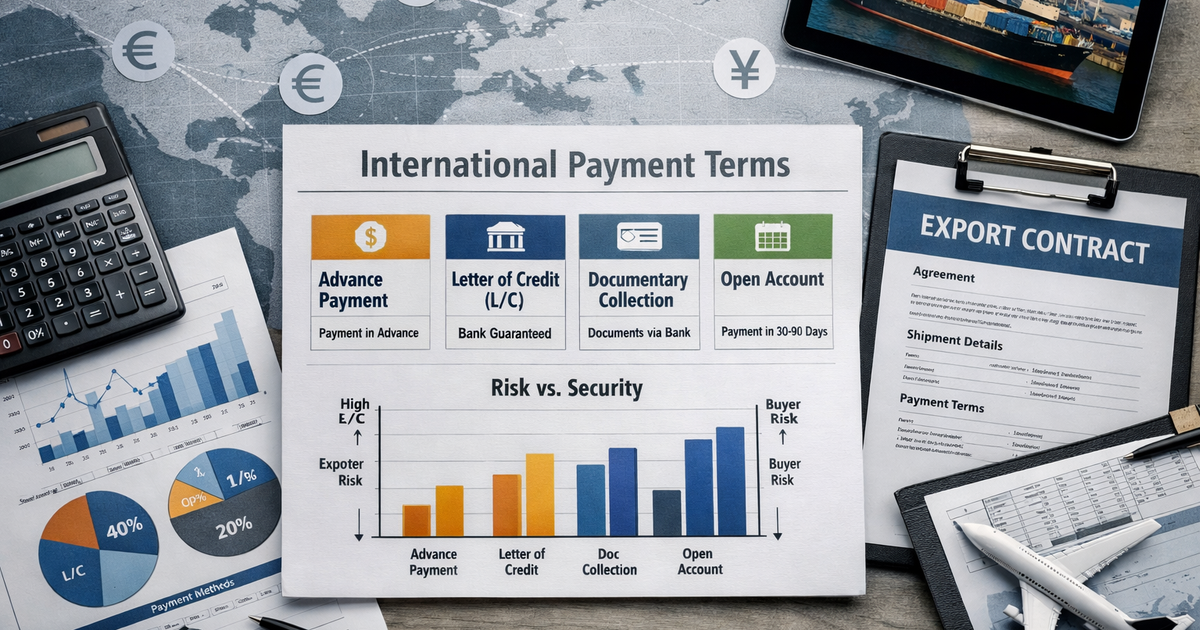
International payment terms are not merely technical arrangements for settling invoices; they are central mechanisms through which firms allocate risk, create trust, preserve liquidity, and make cross-border exchange possible under conditions of uncertainty. In domestic transactions, commercial actors often operate within shared legal systems, familiar banking practices, and relatively predictable enforcement environments. International trade is different. Exporters and importers are separated by distance, currency regimes, political systems, legal jurisdictions, transportation risks, and asymmetric information. Because of this complexity, the timing and method of payment become strategic decisions rather than administrative details.
The purpose of this paper is to examine the logic behind the main payment methods used in international business and to explain why different methods are appropriate in different commercial situations. Payment terms determine when value is transferred, who carries the risk of non-payment or non-delivery, and which institutions are responsible for reducing uncertainty. They influence working capital, pricing, bargaining power, and market access. A payment method that appears simple from an operational perspective may have significant financial consequences for a firm, particularly for small and medium-sized enterprises that lack the liquidity reserves of large multinational corporations.
Payment terms can be understood as a spectrum that runs from maximum security for the exporter to maximum convenience for the importer. At one end is advance payment, where the buyer pays before shipment and therefore carries most of the risk. At the other end is open account, where the exporter ships goods first and receives payment later, usually after 30, 60, or 90 days. Between these extremes are documentary instruments, especially letters of credit and documentary collections, which use banks and trade documents to reduce uncertainty. The choice among these methods reflects the level of trust between the parties, the value and specificity of the goods, the buyer’s creditworthiness, the political and legal environment of the buyer’s country, and the competitive conditions of the market.
The underlying economic problem is that international trade normally requires one party to perform before the other party can fully verify performance. If the exporter ships goods before receiving payment, the exporter faces the possibility that the buyer will delay payment, become insolvent, dispute the goods, or be prevented from paying by currency restrictions or political events. If the importer pays before shipment, the importer faces the possibility that the exporter may fail to deliver, deliver late, or deliver goods that do not match the contract. Payment terms are therefore instruments for managing sequencing risk: they decide which party must trust the other party first and how much institutional support is required to make that trust acceptable.
Advance payment gives the exporter the strongest position because payment is received before production is completed or before goods are shipped. This method is common when the exporter has strong bargaining power, when the goods are highly customized, when the buyer is new, or when the buyer’s country presents significant political or transfer risk. It protects the exporter’s cash flow and eliminates credit exposure, but it can weaken the exporter’s competitiveness because many buyers prefer not to finance a supplier before receiving goods. For the importer, advance payment creates a serious performance risk because legal remedies across borders may be costly, slow, or uncertain. In this sense, advance payment is efficient for risk-averse sellers but may be commercially unattractive in competitive markets.
A letter of credit offers a more balanced solution by replacing direct reliance on the buyer with reliance on the banking system. Under a letter of credit, the issuing bank undertakes to pay the exporter if the exporter presents documents that comply with the conditions stated in the credit. In a confirmed letter of credit, the exporter’s bank adds its own payment undertaking, which further reduces the exporter’s exposure to the buyer, the issuing bank, and the buyer’s country. The International Chamber of Commerce has developed the Uniform Customs and Practice for Documentary Credits, known as UCP 600, which provides widely used rules for documentary credit transactions and emphasizes the central role of documents rather than the physical goods themselves.
The academic significance of the letter of credit is that it demonstrates how institutions substitute for interpersonal trust. The exporter does not need to rely solely on the buyer’s promise to pay; instead, the exporter relies on the bank’s obligation to pay against compliant documents. The importer also receives protection because payment is not released simply because the exporter demands it, but because the exporter has presented documents such as invoices, transport documents, insurance certificates, and inspection certificates that correspond to the agreed conditions. However, this structure also creates a major limitation: banks deal primarily with documents, not with the actual quality or condition of the goods. Therefore, a letter of credit reduces payment risk but does not completely eliminate commercial disputes about performance.
Because letters of credit depend on documentary compliance, precision is essential. A minor discrepancy between the documents and the credit terms can allow a bank to refuse payment or require the buyer to waive the discrepancy. This makes the letter of credit both powerful and demanding. It is particularly useful for high-value transactions, new trading relationships, politically uncertain markets, or situations where the exporter cannot afford the risk of non-payment. At the same time, it is more expensive and administratively complex than simpler payment methods. Firms must therefore compare the cost of the instrument with the value of the risk reduction it provides.
Documentary collection occupies a middle position between the security of a letter of credit and the informality of open account trading. In a documentary collection, the exporter ships the goods and sends the relevant documents through banks. The buyer receives the documents only after paying, in the case of documents against payment, or after accepting a bill of exchange, in the case of documents against acceptance. The banks act as channels for document handling and payment collection, but they do not normally guarantee payment. The International Chamber of Commerce’s Uniform Rules for Collections, known as URC 522, were designed to clarify banking practice in these transactions, including the importance of clear collection instructions and the distinction between documents against payment and documents against acceptance.
The attraction of documentary collection is that it is cheaper and simpler than a letter of credit while still giving the exporter some control over the documents needed to obtain possession of the goods. Nevertheless, the exporter remains exposed to the buyer’s refusal to pay or accept the documents. If the buyer rejects the documents after the goods have arrived, the exporter may face storage costs, resale difficulties, demurrage, legal expenses, and the risk that the goods will lose value. Documentary collection is therefore best suited to situations where the buyer is already known, the market is stable, and the goods can be resold if the transaction fails.
Open account terms shift the balance of advantage toward the importer. The exporter ships the goods and invoices the buyer, and the buyer pays after an agreed credit period. This method is common in established relationships, integrated supply chains, and competitive markets where buyers expect credit as part of the commercial offer. For the importer, open account improves cash flow because goods can be received, processed, or resold before payment is due. For the exporter, however, open account creates credit risk, liquidity pressure, and exposure to late payment. The exporter must therefore rely on credit assessment, internal control procedures, debt collection systems, and often external risk mitigation such as credit insurance.
Open account trade shows that payment terms are also competitive tools. A supplier that offers longer payment periods may become more attractive to buyers, but only if the supplier can finance the delay and absorb possible losses. This is especially important for manufacturing SMEs, which may have to purchase raw materials, pay wages, and finance production long before receiving payment from foreign customers. When an SME extends open account terms without adequate risk management, growth can create financial fragility rather than strength. A large order may increase revenue on paper while simultaneously increasing working-capital pressure and exposure to default.
Export credit agencies play an important role in reducing these barriers. Many governments operate export credit agencies to support national exporters by providing guarantees, insurance, or financing connected to international sales. These agencies do not remove all commercial uncertainty, but they can transfer part of the risk away from the exporter or its bank. In Sweden, Exportkreditnämnden, commonly known as EKN, supports exporters by guaranteeing payment risks in export transactions. EKN describes its purpose as making export transactions more secure by insuring against the risk of not getting paid and by improving financing possibilities for exporters and banks.
The role of an export credit agency is especially significant where payment terms are long, the buyer is located in a higher-risk market, or the project requires substantial financing. EKN’s guarantees can cover risks connected to foreign buyers failing to pay according to agreement, and the Swedish export credit system combines guarantees from EKN with financing capacity from the Swedish Export Credit Corporation. This arrangement allows Swedish exporters and their banks to offer more competitive credit terms while maintaining a more controlled risk profile. Similar institutions exist in other countries, such as UK Export Finance in the United Kingdom, Export Development Canada in Canada, and the Export-Import Bank of the United States. These agencies show that international trade finance is not only a private contractual matter but also part of national economic policy.
At the multilateral level, officially supported export credits are also shaped by international disciplines. The Organisation for Economic Co-operation and Development describes export credits as an area where rules are agreed, implemented, and monitored to create a level playing field among exporters. The OECD Arrangement on Officially Supported Export Credits limits the terms and conditions under which governments can support export financing, including repayment terms, premium rates, and interest-related conditions. This matters because export credit support can otherwise become a form of hidden competition between states. If governments offered unlimited subsidized credit, exporters might compete less on product quality, price, and service, and more on the financial support provided by their governments.
From a theoretical perspective, payment terms reveal three central dimensions of international business. The first dimension is risk allocation. Every payment method decides whether the exporter, the importer, a bank, an insurer, or a public agency will carry the consequences of non-payment, non-delivery, political disruption, or documentary failure. The second dimension is liquidity. Payment terms determine whether the exporter receives funds before production, at shipment, after document presentation, or weeks or months after delivery. This affects working capital and may determine whether a firm can accept a foreign order at all. The third dimension is trust. Payment terms express the maturity of the commercial relationship: new and uncertain relationships tend to require stronger safeguards, while long-term relationships may rely more on open account trading and reputation.
The relationship between payment terms and pricing is also important. A buyer that requests open account terms is effectively asking the exporter to provide short-term credit. This credit has a cost because the exporter must finance the period between shipment and payment, bear the risk of late payment, and possibly insure the receivable. Rational exporters should incorporate these costs into pricing, credit limits, and contract negotiation. Conversely, a buyer that agrees to advance payment or a confirmed letter of credit reduces the exporter’s risk and may be able to negotiate a better price. Payment terms therefore function as part of the total economic value of a contract, not as a separate administrative clause.
For SMEs, the strategic management of payment terms can determine whether internationalization is sustainable. SMEs often enter foreign markets with limited financial buffers, limited legal resources, and less bargaining power than larger firms. If they accept open account terms too early, they may win sales but expose themselves to cash-flow shortages and bad debts. If they insist on advance payment in all cases, they may lose customers to competitors offering more flexible conditions. The challenge is to match the payment method to the risk profile of the transaction. This requires credit checks, country-risk assessment, contract clarity, documentary discipline, insurance options, and careful negotiation with banks and export support institutions.
A practical decision-making approach begins by asking several questions. Is the buyer new or established? Is the buyer’s country politically and economically stable? Are the goods standardized and easy to resell, or customized and difficult to redirect? How large is the order compared with the exporter’s financial capacity? Does the buyer require credit in order to complete the purchase? Are banks willing to confirm a letter of credit or finance receivables? Is export credit insurance available? The answers to these questions help determine whether the transaction should use advance payment, a confirmed letter of credit, documentary collection, open account terms, or a combination of instruments.
In conclusion, payment terms are a structural foundation of international trade because they organize the relationship between risk, trust, liquidity, and institutional support. Advance payment protects the exporter but exposes the importer; open account favours the importer but increases the exporter’s credit risk; documentary collection offers a moderate solution without a bank payment guarantee; and letters of credit use banking obligations and documentary rules to create a higher level of security. Export credit agencies and international rules further shape this system by reducing risk and preventing unfair competition in officially supported finance. For university-level analysis, the key point is that payment terms should not be viewed as isolated techniques. They are economic and institutional mechanisms that allow firms to trade across borders despite uncertainty, distance, and imperfect trust.
Sources
International Chamber of Commerce. UCP 600: Uniform Rules and Practice for Documentary Credits. ICC Knowledge 2 Go. https://2go.iccwbo.org/ucp-600-uniform-rules-for-documentary-credits-config-1+book_version-Book/
International Chamber of Commerce. URC 522: Uniform Rules for Collections. ICC Knowledge 2 Go. https://2go.iccwbo.org/urc-522-uniform-rules-for-collections-config-1+book_version-Book/
Exportkreditnämnden. EKN’s Guarantees. https://www.ekn.se/en/guarantees/our-guarantees/ekns-guarantees/
Svensk Exportkredit. The Swedish Export Credit System. https://www.sek.se/en/the-swedish-export-credit-system/
Organisation for Economic Co-operation and Development. Export Credits. https://www.oecd.org/en/topics/export-credits.html
Organisation for Economic Co-operation and Development. Arrangement on Officially Supported Export Credits. https://one.oecd.org/document/TAD/PG(2023)7/en/pdf